You've probably heard a lot about process based therapy. Here's a quick orientation to it, and then some follow-up readings. I hope that a process-based approach will help empower you to be a more flexible, creative, and effective practitioner.
Process based therapy is not a replacement for other psychological therapies. It's a shift in focus. For example, somebody could do psychodynamic therapy, schema based therapy, positive psychology coaching, or cognitive behaviour therapy in a process based way.
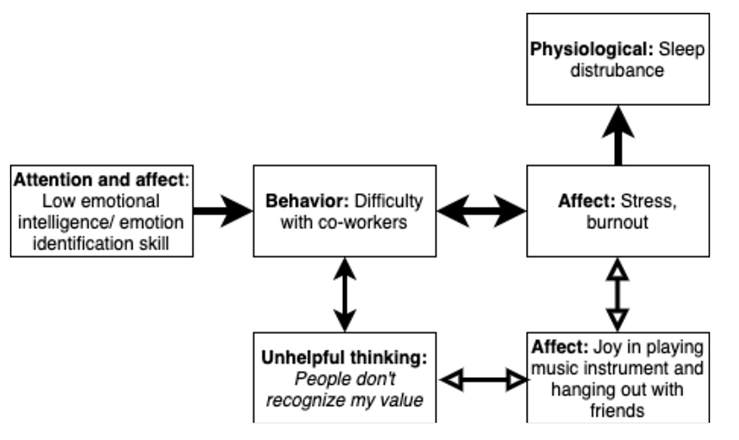
An example of a process-based case conceptualization for a single individual

Process based therapy helps us to shift from thinking in terms of evidence based packages to evidence processes inside those packages. So instead of saying this CBT protocol is evidence based and you have to use the whole protocol with every single person, we can identify the evidence based processes within the protocol.
This gives us a lot more flexibility and creativity, because we don't have to use the whole protocol with every single client, and we can cross therapeutic islands and use techniques from different approaches together, within the same coherent framework. Pretty cool huh?
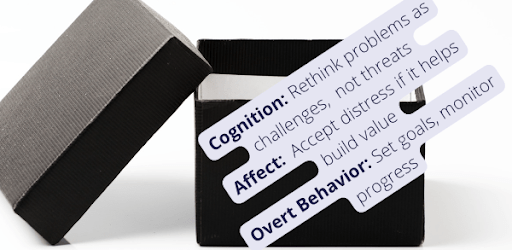
Process-based therapy seeks to look inside therapeutic black boxes, or protocols, to identify the active processes.
The above example illustrates what we're up to here. We often evaluate therapeutic packages like a black box. We don't know what ingredients are inside, and which ingredients we need for each client. A process based approach lets us open the box, and examine what are the evidence-based processes. I've given a few examples here, such as those targeting cognition, affect, and overt behaviour. Once we break the package down into evidence-based processes, we're now free to use components of the package that, based on our case conceptualisation, are most relevant to our client. For example, not every client needs to be taught how to think of problems as challenges rather than threats. Not every client will need an emphasis on goal setting.
The process based metatheory underpinning process-based therapy is called the extended evolutionary metamodel (EEMM; Hayes, Hofmann, & Ciarrochi, 2020). I know that's a mouthful, but don't worry, you can read about it if you'd like to know more. There are follow-up readings below. Here are a couple of important points about the EEMM.
The evolutionary meta-model attempts to provide a kind of common language for all therapies, a periodic table of evidence based processes. All processes can be classified as involving the dimensions of cognition, attention, affect, motivation, self, and overt-behaviour. The figure below presents an example of the process and how they might be linked to the hexaflex and DNA-V models of ACT.
| DNA-V Process Label | Hexaflex Process Label | Extended Evolutionary Meta-model | Purpose of Intervention |
|---|---|---|---|
| Discoverer | Committed Action | Overt Behavior | Use trial-and-error learning. Help people to willingly engage in new or nontypical behaviour, to develop their skills and resources, and expand their context. |
| Noticer | Present moment awareness; acceptance | Attention Affect Physiological states and responses |
Help people notice inner and outer experience and have the capacity to accept rather than avoid or cling to it. Help people attend to the present context. |
| Advisor | Defusion | Cognition | Help people to navigate their context with language and disengage from unhelpful language processes. |
| Values | Values | Motivation | Create contexts that empower people to clarify what they value, choose value consistent action and sustain action across time and hardship. |
| Self-view | Self-as-content Self-as-process Self-as-context |
Self | Help people take perspective on themselves, overcome self-limiting beliefs or categories, view self with compassion, and take actions towards self that are self-enhancing rather than self-destroying. |
| Social-View | All six processes at the social level | All six dimensions above at social level | Help people to take perspective on others, to recognize social interdependence and the value of others, and to behave effectively in social situations. |